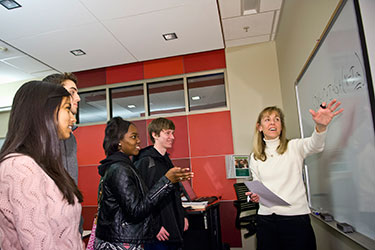
Rochester Institute of Technology - Computer Engineering Technology BS

Computer Engineering Technology BS
Michael Eastman, Department Chair
(585) 475-7787, mgeiee@rit.edu
http://www.rit.edu/cast/ectet/bs-in-computer-engineering-technology.php


Program overview
Embedded systems are at the heart of devices and systems used every day. Computer engineers design embedded systems for medical diagnostic equipment, digital cameras, missile guidance systems, anti-lock braking systems, scanners, copiers, switches, routers, and cell phones. The embedded systems designer requires knowledge of computer hardware and software.

The computer engineering technology major is designed to meet industry’s ever-increasing need for engineers with an in-depth knowledge of hardware and software design and development. The curriculum bridges the gap between these two disciplines by providing a solid foundation in each and integrating them with intensive classroom and laboratory experiences.
From a software perspective, students gain a strong background in cutting-edge development with programming languages currently used in industry. Students learn industry standard approaches to application software development as well as state-of-the-art problem-solving techniques. Students learn techniques for developing applications code and firmware, and they understand and appreciate the difference. Embedded “C” and assembly language programming are performed in numerous courses.
The hardware focus of the curriculum is on digital systems design and development. From low-level gate design to high-end microprocessors and current bus standards, students gain an architectural understanding of computer systems. The curriculum includes in-depth design and analysis of combinational logic, sequential logic and state machines, micro-controller systems, microprocessor systems, and state-of-the-art computer technology. Students perform schematic entry timing analysis and FPGA development in VHDL using industry standard computer-aided engineering tools.
A capstone experience in the fifth year enables students to integrate their hardware and software expertise in a semester-long project course.

The emphasis on hardware and software design, along with a solid foundation in math, science, and the liberal arts, produces graduates who are well-prepared to enter the work force as design engineers or to pursue advanced degrees. Students will gain depth of knowledge and breadth of experience that will inspire them to pursue successful careers in their chosen professional field and embark on a path of lifelong learning.


Options
Students may elect to use the two technical electives and the two free electives to complete an option in audio or telecommunications. Each option consists of four courses.

Cooperative education
The program requires students to complete approximately 50 weeks of cooperative education. Students may begin their co-op experience in the third year of the program. Co-ops may be completed during the academic year or during the summer. Each student is assigned a co-op adviser to assist in identifying and applying to opportunities.

Accreditation
The computer engineering technology major is accredited by the Technology Accreditation Commission of the Accreditation Board for Engineering and Technology ABET, http://www.abet.org.

Curriculum
Computer engineering technology, BS degree, typical course sequence

Rochester Institute of Technology - Civil Engineering Technology BS

Civil Engineering Technology BS
Todd Dunn, Department Chair
(585) 475-2900, gtdite@rit.edu
Scott B. Wolcott, Undergraduate Coordinator
(585) 475-6647, sbwite@rit.edu
http://www.rit.edu/cast/cetems/


Program overview
The civil engineering technology major prepares students for employment in the fields of civil engineering, construction management, and other closely related professions. Students learn civil engineering technology fundamentals from faculty members who have years of practical, professional, on-the-job experience. The major stresses applied engineering, where students work in various laboratory settings to learn about theory, how design parameters are determined, and how to best utilize state-of-the-art equipment and engineering software. In addition, students learn the skills necessary to pursue additional education, certification, or professional licensure. Course work and extracurricular activities are designed to broaden students' involvement in organizations within and outside their profession. These objectives are achieved through a broad-based curriculum that offers students a choice of five elective paths that meet specific career interests.

Program goal
The goal of the civil engineering technology major is to provide an academically demanding education to meet the needs of students and employers by properly preparing them for a successful career after graduation.

Accreditation
The civil engineering technology major is accredited by the Engineering Technology Accreditation Commission (ETAC) of ABET, http://www.abet.org.

Plan of study
The major includes two technical electives and two free electives that can be used to gain additional depth or breadth in civil engineering or construction management. In addition, students may choose to utilize electives to pursue a minor outside of the civil engineering technology major or a professional option within the major. Options are not required, but students may choose to complete an option in construction management, structural design, or water resources to gain a deep understanding of these particular topics and how they impact civil engineering.

Professional options
Students may choose to pursue one of three professional options in construction management, structural design, or water resources. Professional options consist of three courses chisen by the student.

Construction management
The construction management option is ideal for students who have an interest in courses related to the business, management, and technical aspects related to construction.

Rochester Institute of Technology - Chemistry BS

Chemistry BS
Paul Craig, School Head
(585) 475-6145, Paul.Craig@rit.edu
https://www.rit.edu/science/scms

Program overview
The chemistry major prepares students for positions in several fields of chemistry, including professional industrial work in processing and laboratory operations, research and experimental work, supervision of technical projects, and managerial positions. A substantial number of students continue their education and earn advanced degrees in chemistry or pursue careers in pharmacy, medicine, and dentistry.

The chemistry major allows for flexibility in the type and number of chemistry and university-wide elective courses taken by the student. The program also provides students the option of planning an elective concentration in a complementary field such as imaging science, business, graphic arts, psychology, biology, criminal justice, computer science, engineering, environmental science, forensics, mathematics, packaging science, and physics.

Cooperative education
The chemistry major may be completed in four or five years, depending on the amount of cooperative education experience each student elects to complete. Co-op may begin as early as the summer after the first year. Students may elect to complete the BS degree requirements in a traditional four-year program with three summers of co-op work experience. Students who choose to complete co-op requirements during the academic year will be required to extend the length of their program.


Undergraduate research opportunities
We encourage our students to meet the professors in the School of Chemistry & Materials Science early in their time on campus. Many of our students join research labs and engage in research starting as early as their first year. Participation in undergraduate research will open up opportunties to make presentations at local and national conferences. Many of our student researchers also become contributing authors on peer-reviewed manuscripts

Rochester Institute of Technology - Biology BS

Biology BS
Larry Buckley, School Head
(585) 475-7507, ljbsbi@rit.edu
Rosanne Klingler, Academic Adviser
(585) 475-4765, rkssbi@rit.edu
https://www.rit.edu/science/gsols


Program overview
In the College of Science, biology is something that students do, rather than something they merely learn. Courses present biology as it is done by career biologists, and hands-on laboratory and field experience is emphasized. Scientific knowledge is based on research, and students are encouraged to undertake research projects in the college's laboratories.

The biology major prepares students for rewarding positions in occupations related to the life sciences, including biomedical research, scientific management, science journalism, forensic science, ecology and environmental science, agriculture, genetic counseling, and education.

The major includes all of the course work and support services to prepare students to pursue advanced degrees in medicine, dentistry, veterinary medicine, optometry, podiatry, and chiropractic medicine, as well as a wide range of graduate programs in the life sciences.


Cooperative education

Cooperative education is an optional component of the major. More than 65 organizations in private industry, government, and academia employ biology students in full-time paid positions directly related to the students’ academic areas of interest. Co-op positions can be held during the summer and/or during the regular academic year. No tuition is charged for co-op participation. If a student elects to pursue co-op during the regular academic year, they may need to extend the date of graduation beyond the traditional four years.

Roosevelt University - Pathway Program - Pre-law degree: choice of majors

Pre-law degree: choice of majors

Upon completion of your degree pathway program, you will have reached the required English level, acquired academic credits, and integrated into American university life. You then matriculate into Year 2 of an undergraduate degree at Roosevelt University in Chicago.

Your choice of pre-law degrees and social science degrees once you have completed the International Year One pre-law pathway:

Criminal Justice, BA
The Bachelor of Arts degree in Criminal Justice prepares students for leadership roles within the criminal justice field. This pre-law degree program is designed for those who wish to become criminal justice professionals, or who seek advancement in the field. A criminal justice degree also provides a foundation for law school and continuing life-long professional development as a policy-maker.

Graduates of the program are well-placed to succeed in supervisory and management roles in areas including policing, homeland security, courts, corrections, juvenile justice, child and victim advocacy, security and associated support agencies. The courses cover contemporary issues facing the decision-makers of the American criminal justice system, with an emphasis on the skills necessary to become an effective leader. 

International Studies, BA

International studies is an interdisciplinary degree program in the College of Arts and Sciences. At least 5 courses in international studies must be taken:

  • Cross-Cultural Anthropology
  • Principles of Economics I
  • The World since 1500
  • Introduction to International Relations
  • Introduction to Political Science 

Students choose elective courses from the following three tracks: Regional Studies (including courses focusing on Latin America, Europe, Southern cone, Middle East, and Egypt), Developments in the Global System, and Race, Rights, Gender and Activism.

Students may also deepen their learning and gain valuable work experience through internships with an agency or organization that deals with international issues and populations.

Roosevelt University - Pathway Program - 1 graduate-level course Undergraduate business degree: choice of majors

1 graduate-level course Undergraduate business degree: choice of majors

Upon completion of your degree pathway program, you will have reached the required English level, acquired academic credits, and integrated into American university life. You then matriculate into Year 2 of an undergraduate degree at Roosevelt University in Chicago.

Your choices of business degree and management degree majors once you have completed the International Year One business pathway:

Accounting, BSBA
The accounting program exposes students to both established accounting standards and emerging accounting issues. Students earn a Bachelor of Science degree in Business Administration (BSBA).

Courses teach the concepts and skills necessary to provide accounting services for businesses, governmental agencies, and not-for-profit organizations; and to control, plan, and evaluate the results of operations. This accounting degree program provides an advanced accounting education to those seeking employment in:

  • internal and external auditing
  • financial or managerial accounting
  • taxation
  • staff accounting
  • comptrolling
  • public accounting
  • governmental and not-for-profit agencies and institutions
Economics, BA


The Economics degree at Roosevelt University prepares students to analyze economic phenomena in fresh and innovative ways. Students receive a broad view of contemporary economics with special emphasis on non-traditional approaches to theory and policy. Students are challenged to be critical of existing institutions and seek new solutions to problems of economic justice, poverty, and inequality. 

Economics graduates typically pursue careers in business, public service, law, teaching, and research.
Finance, BSBA

The Finance bachelor's degree offers students the opportunity to major in both traditional and emerging financial fields. Courses give students a broad exposure to contemporary issues in the financial world, and the concepts and skills necessary to provide funds for a business and to control, plan, and evaluate the flow of funds through the enterprise.

The Finance program prepares graduates to seek employment in corporate finance, banking, securities exchanges, and personal FINANCIAL planning.

Roosevelt University - Pathway Program - MBA degree: Master of Business Administration

MBA degree: Master of Business Administration


The Pre-Master's Program leads to an MBA degree with a choice of 15 innovative concentrations at Roosevelt University in Chicago, opening a variety of career paths.
The MBA degree prepares students for executive and managerial positions in both the private and public sectors. The degree includes broad preparation in business administration, while allowing for a concentration in a specific business or related area. Emphasis is placed on the development of problem-solving and decision-making abilities.


Roosevelt University's innovative MBA offers small class sizes and personal contact. Teamwork and group projects are stressed, with many case analyses which include written and oral presentations. Above all, each student is expected to share their expertise with classmates.

MBA degree curriculum (37 credits)

Core courses                                Concentration                                 Elective course

Accounting for Executives             
3 courses chosen from a                  1 graduate-level                                                               specific functional area in                  course from another  
                                                      business. See below for                    business program                                                             options.                                              or  another graduate                                                                                                                       school                                    
  • Economics for Decision Makers
  • Finance for Decision Makers
  • Information Resource Management
  • Quantitative Analysis
  • Executive Leadership
  • Strategic Management
  • MARKETING Strategies
You may choose from 15 MBA concentrations:

Concentration in the Heller College of Business:

From a Roosevelt University graduate program outside the College of Business:

ACCOUNTING

MBA course choices include: Asset Valuation; Professional Auditing; International Accounting

ACCOUNTING FORENSICS

MBA course choices include: FINANCIAL Fraud; Anti-Money Laundering; Computer Forensics.

FINANCE

MBA course choices include: FINANCIAL Analysis; Investment Theory; Derivatives

HUMAN RESOURCE MANAGEMENT

MBA course choices include: Workplace Diversity; Employee Selection; Compensation Management

INFORMATION SYSTEMS

MBA course choices include: Database Systems; Systems Analysis; PROJECT MANAGEMENT

INTERNATIONAL BUSINESS

MBA course choices include: International Accounting; Global Issues in Information Systems; International Leadership

MANAGEMENT

MBA course choices include: Business Forecasting; Team Building Skills; Managing Organizational Change

MARKETING

MBA course choices include: Communication and Consumer Behavior; Market Research; International Marketing Analysis

REAL ESTATE

MBA course choices include: Urban Land Economics; Real Estate Law; Construction

Ads